One of the challenges in Global Citizenship and Global Justice Education is helping learners move from understanding theory to using it.
Students (and educators) often ask:
What does critical or decolonial thinking actually look like in practice?
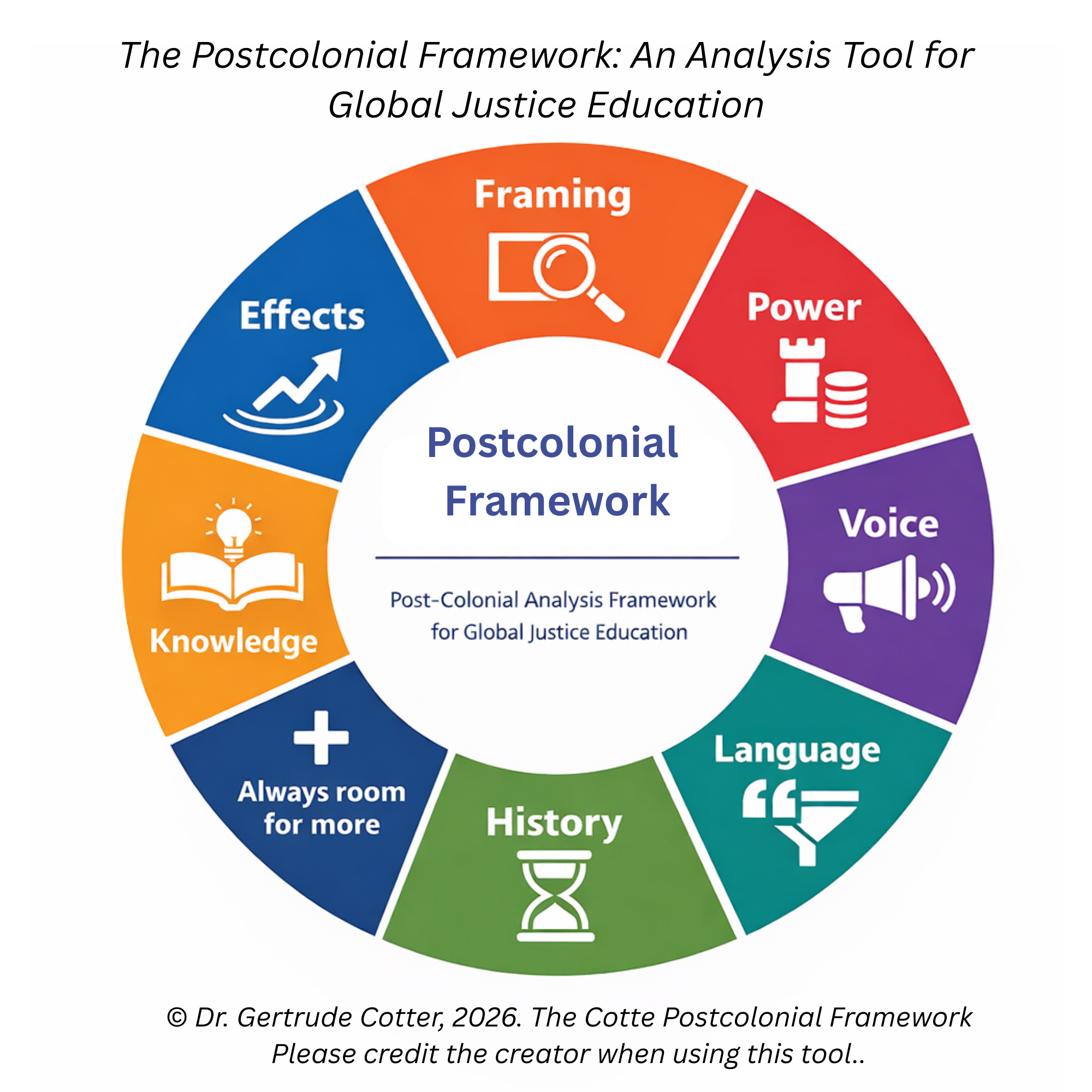
The Postcolonial Framework was developed by Dr Gertrude Cotter as a teaching tool to bridge that gap. It offers a structured, accessible way to analyse texts, policies, cultural artefacts, and everyday narratives through a global justice lens, without requiring specialist theoretical knowledge to begin. This is not the only framework we can use but it is one that might interest those who wish to take a post-colonial and decolonial approach to their global justice work with classes or adult groups.
This framework is now used across higher-education classrooms, professional development spaces, and community learning contexts.
Why a “lens” approach?
Global justice issues are complex. They involve history, power, economics, culture, and knowledge systems all at once. Learners can easily feel overwhelmed or unsure where to begin.
The lens approach:
-
breaks complexity into manageable analytical steps
-
supports critical literacy, not just opinion-sharing
-
helps learners see patterns of power, not isolated examples
-
works across disciplines and contexts
Importantly, the framework is methodological, not ideological. It does not tell learners what to think, but supports them in learning how to read critically.
The Postcolonial Framework
The framework invites learners to examine any text, image, policy, speech, or cultural artefact through seven guiding questions.
1. Framing
How is the issue presented?
What is defined as the “problem” — and what is taken for granted as normal?
This lens helps learners notice how narratives shape understanding before any facts are debated.
2. Power
Who benefits from this framing?
Who holds authority, control, or decision-making power?
Here, learners move beyond surface content to examine underlying power relations.
3. Voice
Who gets to speak?
Who is spoken about but not with?
This lens foregrounds silencing, representation, and whose perspectives are legitimised.
4. Language
What words, metaphors, or categories are used?
What emotional or ideological work does the language do?
Learners begin to see language not as neutral description, but as an active force.
5. History
What historical context is included — and what is missing?
How does the absence of history shape meaning?
This lens is particularly important in global justice education, where colonial histories are often erased.
6. Knowledge
Whose knowledge counts as valid or authoritative here?
What ways of knowing are marginalised or excluded?
This draws attention to epistemic power — a core concern in postcolonial and decolonial scholarship.
7. Effects
What does this text, policy, or narrative make possible?
What actions, attitudes, or policies does it justify or normalise?
This final lens links analysis to real-world consequences.
Where does this framework come from?
The Postcolonial Framework is a pedagogical synthesis, drawing on key traditions in critical scholarship, including:
-
Postcolonial theory (e.g. Fanon, Said, Spivak, Ngũgĩ wa Thiong’o)
-
Decolonial theory (e.g. Quijano, Mignolo, Lugones, Tuhiwai Smith)
-
Critical discourse analysis
-
Critical pedagogy and global justice education
Rather than reproducing theory in abstract form, the framework distils recurring analytical moves into a teaching-friendly method.
Key Postcolonial & Decolonial Thinkers Behind the Framework (Teaching-Friendly Summary)
The Framework is a teaching-friendly synthesis of recurring analytical moves found across these traditions. For educators who want to “go deeper”, the thinkers below offer powerful conceptual tools that map strongly onto the 7 lenses, particularly framing, voice, language, history, knowledge, and effects.
Postcolonial thinkers (what they are known for)
| Cotter Lens | Key postcolonial/decolonial thinkers | Teaching-friendly “core idea” | Useful quote prompt (for your own prep / lecture slides) |
|---|---|---|---|
| 1. Framing | Edward Said, Homi Bhabha, Fanon | The “problem” is not neutral: it is constructed. Dominant framings decide what counts as normal, modern, civilised, threatening, or deserving. | How does this text/image construct the ‘issue’? What is assumed as normal? What is rendered invisible? |
| 2. Power | Fanon, Quijano, Freire | Power is not only political; it is also cultural, psychological, economic, and institutional. Colonial logics persist in modern systems (“coloniality”). | Who benefits materially or symbolically? Who controls resources/decisions? What power structures are hidden behind neutral language? |
| 3. Voice | Spivak, Tuhiwai Smith, Freire | Representation is political: marginalised groups are often spoken about rather than listened to. “Inclusion” can still reproduce domination. | Whose voice is centred as credible? Who is absent? Who is being spoken for? |
| 4. Language | Ngũgĩ wa Thiong’o, Said, Mignolo | Language is not descriptive—it does ideological work. Words, categories and metaphors can justify inequality, colonialism, or “common sense.” | What words / metaphors shape feeling and judgement? What labels are applied to groups? What terms make injustice sound normal? |
| 5. History | Fanon, Said, Quijano | History is selectively told. Colonial histories are often reduced, erased, or turned into “background”. Without history, injustice looks accidental. | What historical context is missing? What “starting point” is chosen—and what does that choice achieve politically? |
| 6. Knowledge | Mignolo, Tuhiwai Smith, Spivak, Lugones | Western knowledge systems often present themselves as universal while marginalising Indigenous/local/embodied knowledge. This is epistemic power. | What counts as evidence? Whose knowledge is treated as objective? What ways of knowing are dismissed as subjective or unscientific? |
| 7. Effects | Freire, Fanon, Lugones, Quijano | Texts and policies do things: they make certain actions possible and others unthinkable. They shape real material consequences and social attitudes. | What does this narrative/policy justify? What attitudes/actions become normal? Who is harmed or protected? |
In this way, the Cotter 7-Lens Framework acts as a bridge: it helps learners practise the analytical moves of postcolonial and decolonial theory in an accessible, classroom-ready form—before they encounter the full academic literature. See suggested readings below.