
Energy Citizenship and Climate Justice: Reimagining Participation in Global Sustainability
By Billy Goodwin
Dr Niall Dunphy, a leading interdisciplinary researcher in the field of energy policy, sustainability, and civic engagement, delivered a critical and timely address on the concept of energy citizenship as part of Praxis Week 2025. His talk, Energy Citizenship and Climate Justice: Reimagining Participation in Global Sustainability, invited participants to interrogate the dominant narratives that frame citizens merely as consumers within the energy system and to imagine new democratic possibilities for a just, inclusive transition.
Position and Research Context
Dr Dunphy is the Director of the Cleaner Production Promotion Unit at UCC and Principal Investigator on several major EU-funded research projects, including:
- ENCLUDE: Investigating how energy citizenship can catalyse decarbonisation.
- ACCEPT: Exploring energy behaviour through living labs and governance mapping.
- IEA Gender and Energy Task: Integrating gender analysis into global energy policy.
- EUB SuperHub: Enhancing EU building certification through stakeholder engagement.
- NaturSea-PV: Advancing sustainable marine photovoltaics via socio-technical assessment.
These projects converge around a key imperative: enabling societal transformation through participatory, interdisciplinary approaches to climate action.
Thematic Overview: Citizenship in Energy Transitions
Opening the session, Dr Dunphy invited attendees to unpack the meaning of “citizenship” in the context of sustainability. Responses varied, from seeing citizenship as community belonging (Ross) to critiquing its inherent exclusions (Marina Bell). Ultimately, said interjections set the tone for a nuanced exploration of identity, agency, and justice.
Niall responded to these interjections by delivering a thoughtful discussion on broadly held interpretations of citizenship. Namely, Civic Republican Citizenship, an idea which focuses on duty, voting, and public service, often associated with masculine-coded values like courage and rationality. Next, Niall introduced the idea of Cosmopolitan Citizenship, a form of citizenship which is framed by ethical obligations to shared humanity, echoing Diogenes’ idea of being a “citizen of the world”. Further, both models were also expanded to reflect care-based and feminised dimensions of participation.
Crucially, Dunphy argued that the private sphere [homes, families, daily practices] must be recognised as critical sites of civic engagement, particularly in energy systems historically dominated by technocratic, market-based paradigms. To expand on this Niall reflected on his and Lennon’s (2023) research which describes their six modes of energy citizenship.
- Consumption-Based Participation: The citizen as passive recipient within centralised energy systems—an “energy customer” rather than a civic agent.
- Market-Based Participation: The “active consumer” who exercises agency through smart purchasing—often accessible only to the economically privileged.
- Cooperative/Community Participation: Citizens engaging collectively in energy generation or governance (e.g. energy co-ops), a potentially transformative mode.
- Representative Participation: Engagement through elected bodies or consultative forums, often tokenistic or elite-driven.
- Deliberative Participation: Genuine involvement in decision-making processes, based on dialogue, mutual learning, and situated knowledge.
- Resistance-Based Participation: Civic resistance to imposed systems—such as public opposition to energy infrastructure (e.g. Corrib gas pipeline, Cobh incinerator, both of which were provided by Stephen Thornhill and others during the discussion at the end of Niall’s talk).
Accordingly, Niall argued that these modes challenge simplistic ideas of “participation” and show that energy citizenship must account for material inequality, historical injustice, and competing visions of the good life.
Critical Reflections on the State and Technology
While praising Ireland’s untied aid and human rights focus, Balfe noted its role as a hub for fossil fuel finance and weak corporate regulation, thus showing how policy and practice can pull in opposite directions.
Participation and Radical Hope
Dunphy offered a trenchant critique of techno-utopianism – the idea that technological innovation alone will drive climate transitions. As such, for Niall, over-reliance on carbon taxes or “smart” solutions risks excluding marginalised groups and ignoring deep socio-cultural transformations. Hence, he emphasised that while technologies to decarbonise have long existed, their uptake is hampered by political inertia and fossil fuel lobbying. He asked provocatively: Why would we expect oil companies to lead the transition away from their own profit model? Thus, energy transitions, Dunphy insisted, require shifts in practice as well as infrastructure. Everyday behaviours, values, and social relationships must change and that change must be co-produced with communities, not imposed from above.
Energy Citizenship as a Site of Exclusion
Echoing Elaine O’Mahony’s intervention, Dunphy stressed that “citizenship” is as much about exclusion as inclusion. Energy policy often assumes a universalised/middle-class actor, which ignores those without economic or social agency. This leads to what he called “energy serfdom,” where the burden of transition falls unevenly on the vulnerable. Thus, he argues that “Energy citizenship must not be a euphemism for passive compliance or middle-class virtue signalling. It must be a political claim rooted in rights, justice, and care”.
From Transaction to Transformation
Historically, the citizen’s relationship to energy has been framed as transactional. Dunphy challenged this model, calling for a reimagining of energy use as a social, cultural, and ethical act. Energy citizenship, he argued, should not be something one becomes through consumption, but something that emerges through engagement with others, with institutions, and with the earth. Evidently, such redefinitions move energy from a private commodity to a public concern, while also recasting it as a shared, relational domain that touches every part of our lives.
Closing Dialogue and Reflections
The post-talk discussion grounded these ideas in local and national cases. Stephen Thornhill cited opposition to the proposed incinerator in Cobh; others referenced the long resistance to the Corrib gas pipeline – both exemplifying resistance-based energy citizenship and the implications which arise when citizens are excluded form discussions in the first place.
Participants expressed concern about the manipulation of public discourse, the marginalisation of working-class and rural voices, and the dangers of greenwashing. Dunphy responded with urgency: unless participation becomes meaningful and inclusive, we risk deepening the inequities we claim to solve.
Conclusion
Dr Niall Dunphy’s contribution to Praxis Week 2025 was both intellectually rigorous and morally compelling. By framing energy citizenship not merely as access or efficiency, but as a dynamic of rights, responsibilities, resistance, and relationality, he invited participants to join a broader movement for democratic, just, and humane energy transitions.
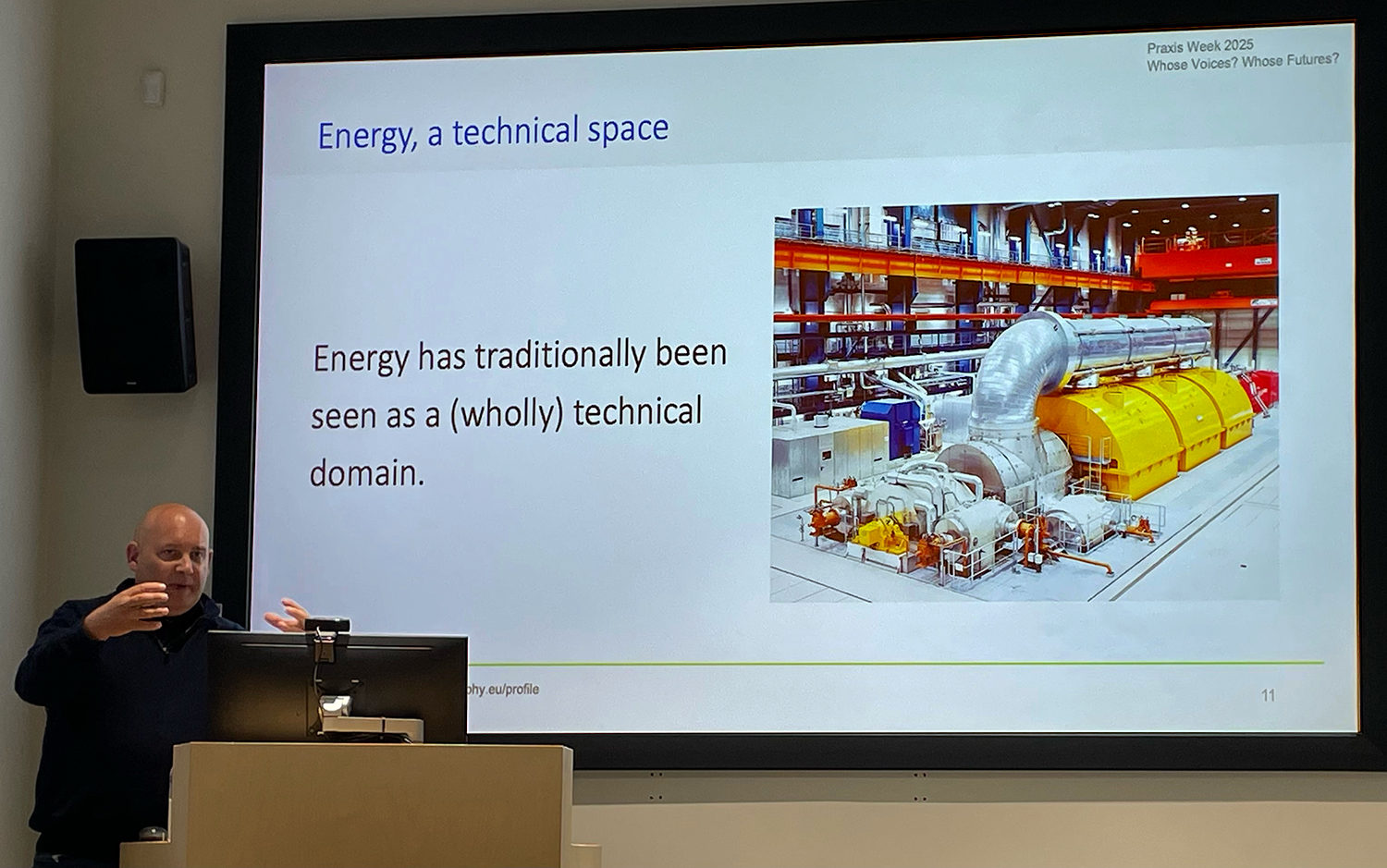
Dr Niall Dunphy on energy (B Goodwin, 2025).
Bill Goodwin: PhD researcher in sociology, digital media, and critical discourse.
Dr. Gertrude Cotter: Lecturer in Global Citizenship Education at UCC and academic coordinator of the Praxis Project.
