
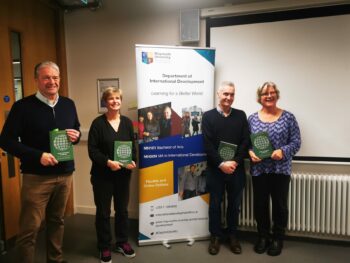
Congratulations to the the editors of a new and important book about Global Education in Ireland.
The book ‘Global Education in Ireland: Critical Histories and Future Directions’ is edited by:
Eilish Dillon (Anthology Editor) , Niamh Gaynor (Anthology Editor) , Gerard McCann (Anthology Editor) , Stephen McCloskey (Anthology Editor) See image to the left of editors Gerard, Niamh, Eilish and Stephen.
With contributions from: Michael Doorly, Aoife, Titley, Elaine Nevin, Bernie Grummel, Benjamin Mallon, Liam Wegimont, Douglas Bourn, Frank Geary, Mella Cusack, Anne Dolan, Valeri Duffy, Caroline Murphy, Audrey Bryan, Davild Nyaluke, Alice Feldman, Barbara O’Toole and Ebun Joseph
It was launched yesterday at Maynooth University. See some of the participants below!

Global Education in Ireland
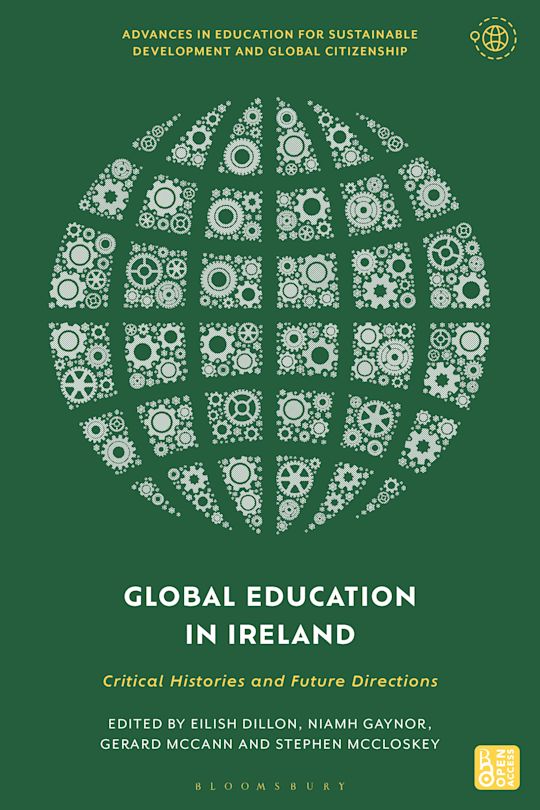
Critical Histories and Future Directions
The ebook editions of this book are available open access under a CC BY-NC-ND 4.0 licence on bloomsburycollections.com. Open access was funded by Maynooth University.
https://www.bloomsbury.com/uk/global-education-in-ireland-9781350380387
Description
This open access book brings together leading global education (GE) practitioners and academics to, for the first time, provide a history of GE in Ireland. Ireland is regarded as a leader in the field of GE worldwide, with a rich history going back to the 1970s. Despite this, there is a lack of reflection on its role and contribution to GE internationally. This book bridges this gap, critically exploring the history of global education policy and practice in the Irish context from different perspectives from across the education spectrum in Ireland, and internationally. The contributors explore the philosophical, pedagogical and globalisation influences on GE, as well as policy trends and curriculum developments. The range of topics discussed include: GE and the sustainable development goals; global citizenship education; activism; solidarity; and critical pedagogy. The role of institutions and other stakeholders are discussed as well as the challenges for transformative practice. Alongside thematic chapters, practical case studies are introduced which illustrate GE practice over time. Relevant to practitioners of global education in Ireland and beyond, the book puts forward a critical, radical and decolonial GE.
I draw your attention to an Angel webinar on the book which will be held Tuesday 12th November – you may like to circulate information about it to your networks – https://angel–network.net/WS_GE_Ireland
I have only just read the book but here is an initial Summary of Critical Histories and Future Directions of Global Education in Ireland
This book provides a comprehensive exploration of the evolution of Global Education (GE) in Ireland, highlighting the challenges, opportunities, and future directions for educators and practitioners. It critically examines the historical, social, and political dimensions that have shaped GE and Global Citizenship Education (GCE) in Ireland, offering reflective insights and innovative case studies that illuminate the current landscape and the need for a rethinking of educational approaches to global justice.
Part 1: Foundations of Global Education in Ireland
The opening chapters explore the historical roots of Global Education in Ireland, focusing on its strong ties to development education (DE) and its evolution alongside international policy developments and civil society movements. The book highlights the importance of DE in addressing unequal Global North-South relationships and the critical role Irish Aid and NGOs have played in shaping the GE landscape.
The book also discusses the growing recognition of global citizenship as a central theme within education, with the Sustainable Development Goals (SDGs) acting as a catalyst for integrating GCE into national and international education policies. However, there is an ongoing tension between the transformative aims of GCE and its institutionalisation within systems that prioritise skills, economic productivity, and neoliberal objectives.
Part 2: Global Citizenship Education in Context
This section delves into the theoretical underpinnings of GCE, examining how it has been influenced by critical pedagogical theories, neoliberal policies, and the emergence of neoliberalism. Audrey Bryan critiques the “skillification” of GCE, where a focus on social-emotional learning (SEL) and specific competencies, like empathy and critical thinking, has depoliticised GCE. This shift towards an individualistic, brain-centred approach, she argues, undermines GCE’s original radical goals of addressing structural injustice and fostering collective political action.
The book discusses how corporate interests and EdTech industries have capitalised on these trends, framing global citizenship as a set of market-driven skills necessary for participation in a digitised, globalised economy. Bryan calls for a re-centring of GCE on its emancipatory roots, resisting the trend of reducing global challenges to issues that can be solved through individual skills alone.
Part 3: Decoloniality and Global Justice Education in Ireland
A recurring theme throughout the book is the need for decolonial approaches to GCE in Ireland. The authors emphasise the importance of challenging Eurocentrism and integrating Indigenous, Global South, and non-Western perspectives into education. Decolonial theorists like Sabelo Ndlovu-Gatsheni and Walter Mignolo inspire discussions on the epistemic violence perpetuated by Eurocentric curricula and the urgency of “epistemic justice” in education.
Barbara O’Toole, David Nyaluke, and Ebun Joseph provide practical examples of how decoloniality can be applied within initial teacher education (ITE) and higher education in Ireland. Their contributions stress the importance of confronting Ireland’s own colonial history and its complicity in global power structures, while also promoting a more critical and reflexive approach to global justice education.
Part 4: Challenges and Opportunities in Irish Global Education
The book also addresses the practical challenges faced by educators and institutions in implementing critical GCE. It critiques the managerialism and neoliberal constraints that shape educational policy, emphasising the need for a more participatory and reflexive approach. Government support is essential, but the book highlights how policies often fall short of fostering radical and critical GCE. The book calls for a balance between strategic government involvement and the autonomy of civil society organisations to ensure that GCE retains its transformative potential.
The tension between theoretical ideals and practical implementation is discussed, particularly in terms of educator training, curriculum development, and engagement with critical global issues like climate justice, human rights, and colonialism. The authors argue for a renewed focus on empowering educators to foster critical thinking, ethical engagement, and political activism in their students, despite institutional and funding constraints.
Part 5: Case Studies on Creative and Decolonial Approaches to GCE
The final section presents two in-depth case studies that illustrate innovative, creative, and decolonial approaches to GCE in Ireland. The first case study focuses on Poetry Ireland’s ‘Writers in Schools’ program, which integrates creative writing and storytelling into GCE, offering students an experiential and emotionally connected way of engaging with global issues. The program highlights the role of creative methodologies in fostering empathy and critical reflection, showing how GCE can go beyond traditional content-based learning.
The second case study, from Comhlámh, explores the organisation’s shift towards depth education, inspired by decolonial theory and critical pedagogy. The focus is on fostering reflexivity and challenging mainstream narratives about global crises. Comhlámh’s educational programs encourage participants to critically reflect on their own complicity in global injustice and to engage in solidarity-building rather than seeking simplistic solutions. This case study highlights the importance of discomfort, reflection, and open-ended learning in fostering meaningful global citizenship.
Conclusion: Reflections and Future Directions
In the concluding chapter, Eilish Dillon reflects on the key themes emerging from the book. The author stresses the importance of maintaining criticality and radicalism in GCE, particularly in a context shaped by neoliberal and managerial pressures. The book highlights the need for government support and strong civil society engagement, while cautioning against the risks of co-optation by state interests.
Dillon calls for educators, researchers, and activists to continue challenging power structures and promoting alternative, decolonial, and feminist perspectives in GCE. There is a need for ongoing reflexivity, creativity, and collective action in addressing the complex and intersecting crises of poverty, inequality, climate change, and exploitation.
Ultimately, the book emphasises that while GE and GCE in Ireland have made significant strides, much remains to be done to reclaim the radical roots of global education and to ensure it can respond to the urgent global challenges of our time.
Reference to the Praxis Project
I would like to acknowledge and thanks the authors for referencing UCC’s Praxis Project as a case study within the context of examining various approaches to global education in Ireland. It appears specifically in Part II: Philosophical, Pedagogical and Political Influences, under Chapter 10, titled “Section 2 Case Studies – Afri; Trócaire’s Climate Justice Project; Praxis Project University College Cork.”
In this section, the Praxis Project is presented as an example of practical engagement with Global Citizenship Education (GCE) through creative and critical methods. The project is mentioned alongside other organizations, such as Afri and Trócaire, to highlight different ways institutions in Ireland incorporate GCE themes like climate justice, peace, and social activism. The book explores how the Praxis Project has been instrumental in fostering a space for reflective and active learning, particularly at University College Cork. By embedding GCE into educational settings, the Praxis Project encourages students and educators to consider complex social and environmental issues, connecting theory with real-world activism.
In its analysis, the book acknowledges the Praxis Project’s contributions to GCE by offering participatory workshops, facilitating discussions, and creating tangible projects that aim to bridge academic learning with social action. The project is presented as an example of how GCE can be implemented in higher education and is referenced as a model for incorporating social justice and development education themes in university curricula. The case study format provides insights into its methodologies and the challenges faced, such as balancing critical pedagogy with institutional constraints.
Dr Gertrude Cotter
