
Contents (go to): Introduction ¦ Support ¦ Identity & visibility ¦ Colonialism ¦ Legal status ¦ Queer approaches ¦ Appendix

A Praxis Resource for Third-Level Educators
Author: Richard Keyes McDonnell
Principal investigator: Dr Gertrude Cotter
The Praxis Project, School of Education, UCC, September 2024

 Full resource: “Global LGBTQ+ experiences: A Praxis resource for third-level educators” is available for download in PDF format at
<http://praxisucc.ie/wp-content/uploads/2024/10/LGBTQ_v3_colours_17oct2024.pdf>
(Opens in a new tab or window. To download, right-click and “Save link as”: PDF = 3MB.
If you see the message “This file can’t be downloaded securely”, please hover over the message to the ellipses “…” and select “keep”, and “Keep anyway“).
Introduction
This resource aims to provide third-level educators with a brief introduction to LGBTQ+ experiences in a global context, and how an educator may encourage discussion of these experiences in their own teaching and discipline; it will provide an introduction to some key supports, and a number of resources to help educators become familiar with the topics and issues concerning LGBTQ+ people and communities, as well as an introduction to the rich vocabularies and iconography used by the LGBTQ+ community and activists.
This resource’s focus is mainly historical: it will first introduce a brief introduction to Irish LGBTQ+ history, highlighting the key legislative developments – the history of legislative change has been a common approach in LGBTQ+ historiography – but the purpose here is to emphasise it is not the only way to approach this history. The purpose of this will be to set Ireland’s path to decriminalisation in a global context, as a way to consider the status of LGBTQ+ criminalisation across the globe today: what can their histories tell us about the way in which societies currently criminalise, tolerate, or protect LGBTQ+ people? How does a narrative of LGBTQ+ history globally based on legislative development potentially preclude an understanding of the multi-dimensional nature of LGBTQ+ activism and liberation, and importantly, how might it limit the effectiveness of GCDE practitioners and their work?
This resource aims to prompt questions concerning how we engage in the discourse of history itself, as a means to consider the values and ideologies that constitute GCDE, and consider how GCDE: what do we mean by progress and development, and how can we ensure that GCDE models of education and pedagogy are able to critically advocate for change and take action, to ensure that LGBTQ+ people are truly liberated?
A critical approach to GCDE
Importantly, the project seeks to actively promote and encourage critical reflective engagement with the meaning and effectiveness of development education and global citizenship education.
What is Global Citizenship and Development Education (GCDE)?
What kinds of frameworks, models, and values are informing and influencing the concepts of global citizenship and development in GCDE?
The importance of considering these fundamental questions:
- What does it mean to consider the experiences of LGBTQ+ people in the context of global citizenship and development education?
- What metrics do GCDE practitioners consider when assessing whether ‘progress’ has been made in any given situation?
- Should a resource that is concerned with LGBTQ+ people also be concerned with other issues, such as queer theory, anti-capitalism/critiques of neoliberalism?
- If a GCDE model does not consider these other issues in both (i) its introspection of itself as a discipline, and (ii) in the issues that it studies, does it risk precluding a full understanding of how and why LGBTQ+ persons are marginalised and exploited (and indeed, that the conditions for the marginalisation and exploitation of any persons can arise) in the first place?
There is a delicate need to balance the focus of LGBTQ+ historiography on recognising the very real positive impacts of legislative change – for example, for the obtaining of same-sex marriage rights – whilst not silencing alternative and radical forms of friendship, relationships, intimacy, and sexuality.
Furthermore, it must not overshadow the continued oppressions and harms that LGBTQ+ folx and communities face even when legislative victories are secured:
‘Although the landmark verdict decriminalizing homosexuality in India in 2018 led to the protection of the rights of the LGBTQIA+ (Lesbian, Gay, Bisexual, Transgender, Intersex, Queer/Questioning, Asexual) community, the quality of their lives has not improved in a significant manner. Many challenges persist concerning basic human rights, such as housing (Chandran, 2014), accessing public spaces in India (Gupta, 2022), and abandoning homes due to lack of acceptance by family members (Gupta, 2017). This leads to significant mental, emotional, and physical trauma to living in the Indian society as an openly LGBTQIA+ person (Gaur et al., 2023, Sheshadri et al, 2024, 2).
This highlights the importance of ensuring that educators unfamiliar with LGBTQ+ history and activism are aware that it historically, and presently, has for many LGBTQ+ people constituted far more than single-issue politics: ‘part of what the contemporary mainstreaming of queerness does is to obscure the real and historically productive convergences between queer politics and other forms of struggle’ (Ferguson, 2019, 19). Indeed, as Roderick Ferguson notes, in comparison to the Stonewall riots, the Compton’s Cafeteria Riot in August 1966 has largely been overshadowed: a riot in protest against state violence, whose participants were ‘not simply members of San Francisco’s gay community, but were also those who most often have to resist police oppression: street youth, gay and lesbian people of colour, sex workers, drag queens, transgender, and gender-nonconforming people’ (Ferguson, 2019, 115).
Ferguson sought to emphasise this in his re-telling of the Stonewall riots. He highlights the perspective of the Latinx co-founder of the Street Transvestite Action Revolutionaries Sylvia Rivera, who recalled ‘all of us were working for so many movements at the time. Everyone was involved with the women’s movement, the peace movement, the civil rights movement’ (Ferguson, 2019, 18). Similarly, the Asian-American lesbian activist Merle Woo emphatically asserted the multi-dimensional and intersectional underpinnings of the Stonewall revolt:
Stonewall’s customers were mostly Black and Puerto Rican, young teenage street queens, dykes, and effeminate gays […] This was the night that drag queens, transgendered folks, lesbians, and gays said NO! No more to gay oppression, police brutality, societal contempt. The homophobia that had oppressed so many for so many years would no longer be tolerated. […] Did they say “No” to racism because they were Black and Puerto Rican? Or “No” because of their gender or sexual orientation? Was it “No” because they were poor and working class? It was all those things […] They challenged the dysfunctional monogamous nuclear family, its patriarchal values, oppression of women and children, and sermons that sex is for procreation only’ (Ferguson, 2019, 46-47).
Ferguson also emphasises the ‘broad-based emancipation’ advocated for by revolutionary LGBTQ+ organisations, such as the Third World Gay Revolution’s 16 Point Platform which sought “‘the right to self-determination of all Third World and Gay Revolution’, ‘the right to self-determination over the use of our bodies; the right to be gay anytime, anyplace; the right to free physiological change and modification of sex on demand’, ‘liberation for all women’, ‘guaranteed income or employment, regardless of sex or sexual preference’” (Ferguson, 35). These broad-based approaches, which often included critiques of capitalism and consumption, affected efforts to sustain radical LGBTQ+ publications; according to Katherine Sender, ‘The explicit critique of capitalism and consumption in radical gay and lesbian feminist magazines was one reason these magazines halted production after relatively short lives, because such a critique precluded the development of sufficiently strong relationships with the more lucrative advertisers’; (Ferguson, 2019, 59).
Ferguson’s emphasis on the key role that non-conformative drag queens, and transgender folks play in this revolutionary shift, finds echoes in Shon Faye’s assertion in her major work, The Transgender Issue (2021), that:
The liberation of trans people would improve the lives of everyone in our society. I say ‘liberation’ because I believe that the humbler goals of ‘trans rights’ or ‘trans equality’ are insufficient. Trans people should not aspire to be equals in a world that remains both capitalist and patriarchal and which exploits and degrades those who live in it. Rather, we ought to seek justice – for ourselves and others alike. […] The demand for true trans liberation echoes and overlaps with the demands of workers, socialists, feminists, anti-racists, and queer people. They are radical demands, in that they go to the root of what our society is and what it could be (Faye, 2021, xiv).
Michael G. Cronin undertook a similar approach to Ferguson in the context of Irish LGBTQ+ history in their work Sexual/Liberation, published by the Cork University Press in 2022. Cronin highlights the influence of Herbert Marcuse’s philosophy in their approaches, noting that ‘as Marcuse recognised, and this is a vital insight of twentieth-century radical feminist, Marxist and anti-colonial thought, a revolution confined to institutions, to economic and political structures, is doomed to failure to the degree that it neglects to revolutionise human consciousness’ (Cronin, 2022, 19). Cronin acknowledges this tension in LGBTQ+ historiography with regard to acknowledging successes in the arena of reform, whilst also advocating for fundamental changes to combat the sources of systemic harm, in their analysis of Kieran Rose’s Diverse Communities: The evolution of lesbian and gay politics in Ireland, published in 1994. In considering Rose’s account of the Gay and Lesbian Equality Network (GLEN), Cronin argues that the LGBTQ+ movement in Ireland became more centralised, moving away from:
‘[…] collective mobilisation but a small, [to] a highly focused group speaking for a minority and mediating between that minority and the wider society. The chosen political terrain would now be the nexus of media, academia, non-governmental organisations, state bodies and party politics where policy is formulated, public opinion nudged in required directions and politicians and civil servants lobbied through multiple forums of varying transparency. The central objective was not revolutionary transformation of the social order but the attainment of “equality” within the existing social and economic structures’ (Cronin, 2022, 103-104).
This particular passage is insightful for GCDE; we again find ourselves in a delicate situation where we must alert to the potential risks that the ‘existing social and economic structures’ to which in equality is sought, may be the source of the systemic harms facing LGBTQ+ folx (and many other marginal groups) in the first place, whilst not ignoring the very real and measurable improvements to the wellbeing of LGBTQ+ folx and communities that were achieved, if even limited to legislative reform.
Radicality too, has not only been used to articulate responses or to make criticisms with respect to systemic harms or political systems, but also to positively imagine new queer futures. Sophie K. Rosa, in their book Radical Intimacy, advocates for a radical approach to intimacy via ‘political radicalism: a politics with imagination and abolitionism at its core’, situating explorations of intimacy in self-care, love, friendship (e.g. platonic intimacy), sex, families, and death. For Rosa, ‘“radical intimacy” aims to get to the root of intimacy as we know it. It explores the ways capitalism psychically and materially predetermines, infiltrates and thwarts our intimate lives (Rosa, 3-4). A GCDE model which seeks to advocate for social justice and the rights of the LGBTQ+ community must understand the important role that radical intimacy has for LGBTQ+, for it is so central to LGBTQ+ activism the desire to make endless our imaginative possibilities for love, and to abolish both the physical and mental shackles which determine who and how many we love, how we identity, how we associate, and how we commune.
Further reading
Anzaldúa, Gloria E. Light in the Dark (Luz en Lo Oscuro): Rewriting Identity, Spirituality, Reality. Edited by Analouise Keating. Durham: Duke University Press, 2015.
Butler, Judith. Frames of War: When is Life Grievable? Verso: London, 2016.
Butler, Judith. Gender Trouble. Abingdon: Routledge, 1990.
Cronin, Michael G. Sexual/Liberation. Cork: Cork University Press, 2022.
Faye, Shon. The Transgender Issue: An Argument for Justice. London: Penguin Books, 2021.
Ferguson, Roderick A. One-Dimensional Queer. Cambridge: Polity Press, 2019.
Gevisser, Mark. The Pink Line: The World’s Queer Frontiers. London: Profile Books, 2021.
Kerrigan, Páraic. Reeling in the Queers: Tales of Ireland’s LGBTQ Past. Dublin: New Island Books, 2024.
Robinson, Padraig. Gaze Against Imperialism. Berlin: Metaflux Publishing, 2019.
Rosa, Sophie K. Radical Intimacy. London: Pluto Press, 2023.
Sheshadri, Shruti, and Agharsh Chandrasekaran. ‘Hopelessly AroAce: An Exploration in the Margins. International Journal of Human Rights Education 8:1 (2024): 1-11.
Support
List last updated on 10 September 2024

Cork Support
- Cork Sexual Violence Centre, 5 Camden Place, Cork.
The Centre provides services to survivors of rape, sexual assault, and child sexual abuse. There is no ‘typical’ person who comes to the Centre – our clients are both young and old, women and men, of all different nationalities and ethnicities. The door of the Sexual Violence Centre is open to everyone, irrespective of the nature of the sexual violence they experienced or when it occurred.
Available at <https://www.sexualviolence.ie/> (Opens in a new tab or window). - Gay Project, South Parish Community Centre, Sawmill Street, Ballintemple, Cork.
Supports gay, bi+, trans and queer men, celebrates sexuality and gender diversity, advocates for LGBTQ+ human rights and policy protections. (See Also: Gay Information Cork, Tele: 1800 929 539, Tuesday 18:30-22:00).
Available at <https://gayproject.ie/> (Opens in a new tab or window). - Gender Rebels Cork.
Gender Rebels Cork is a group based in Cork City which advocates and supports all transgender, non-binary, intersex, and gender non-conforming individuals aged 18+.
Available at <https://genderrebels.ie/about/> (Opens in a new tab or window). - Lesbians and Bisexual women in Cork (LINC), 11A White St, Cork.
For over twenty years, Lesbian and Bisexual women in Cork have been providing support services for others in our community and have been active in promoting equality for Lesbian and Bisexual women (Trans & Non-binary inclusive). (See Also: Cork Lesbian Line, Tele: 1800 929 539, Wednesday, 18:30-21:30).
Available at <https://www.linc.ie/about/> (Opens in a new tab or window). - Sexual Health Centre, 18 South Mall, Cork.
Provides up-to-date information, support, testing and counselling in the areas of: Sexual Health, Wellbeing, Sexuality.
Available at <https://www.sexualhealthcentre.com/> (Opens in a new tab or window).
National Support
- Belong To LGBTQ+ Youth Ireland.
The national LGBTQ+ youth organisation. Since 2003, Belong To has grown from a youth project into a unique national services and advocacy organisation with and for LGBTQ+ children and young people. Youth services, which inform our research, education work and a development approach, enable us to provide solution-based advocacy at an institutional and public level.
Available at <https://www.belongto.org/about/who-we-are/> (Opens in a new tab or window). - Better Out Than In Hub, Belong To LGBTQ+ Youth Ireland.
Better Out Than In strives to promote a healthier relationship with mental health and wellbeing amongst 14-23 years olds in Ireland who are LGBTQ+.
Available at <https://www.belongto.org/support-for-me/better-out-than-in/> (Opens in a new tab or window). - Jigsaw, 16 Westland Square, Pearse Street, Dublin 2, Dublin.
We give families, educators, and those who support young people’s mental health ways to cope and the skills to be there for young people.
Available at <https://jigsaw.ie/> (Opens in a new tab or window). - LGBT Ireland, 80 Dame Street, Dublin 2, Dublin.
LGBT Ireland is a national organisation underpinned by localised knowledge and responses. Together with our network members, we provide support, training, and advocacy which aims to improve the lives of LGBT+ people across Ireland.
Available at <https://lgbt.ie/our-services/> (Opens in a new tab or window). - Outhouse LGBTQ+ Centre, 105 Capel Street, Dublin 1, Dublin.
Outhouse is a space for LGBTQ+ people to connect with one another, with their community, and with themselves. We are a space for support, a space to feel safe, a space to be understood.
Available at <https://outhouse.ie/> (Opens in a new tab or window). - Spunout, Sean MacBride House, 48 Fleet St., Dublin 2, Dublin.
Spunout is Ireland’s youth information and support platform, working towards an Ireland where all young people are supported and empowered to thrive.
Available at <https://spunout.ie/> (Opens in a new tab or window). - Transgender Equality Network of Ireland (TENI).
We offer a range of support services that aim to increase the well-being of trans people and their families by providing support that mitigates common experiences of isolation, misunderstanding and exclusion.
Available at <https://teni.ie/trans-healthcare-another-way-is-possible/> (Opens in a new tab or window). - National Action Group for LGBTI+ Traveller & Roma Rights.
The National Action Group for LGBTI+ Traveller & Roma Rights is a collective that aims to increase the promotion, protection, inclusion, and celebration of LGBTI+ Traveller and Roma individuals and their families – within their communities and within Traveller & Roma and LGBTI+ organisations and services.
Available at <https://travandromalgbti.ie/> (Opens in a new tab or window).
For further support, services, and organisations across Ireland, see the following directories:
LGBT Ireland
- LGBT Centres and Groups.
Available at <https://lgbt.ie/find-support-in-your-area/> (Opens in a new tab or window). - LGBT Youth Groups.
Available at <https://lgbt.ie/lgbt-youth-groups/> (Opens in a new tab or window). - Local & National Helplines.
Available at <https://lgbt.ie/local-helplines/> (Opens in a new tab or window). - Trans Peer Support Groups.
Available at <https://lgbt.ie/trans-peer-support-groups/> (Opens in a new tab or window). - Local Helplines.
Available at <https://lgbt.ie/connecting/> (Opens in a new tab or window).
Cork Pride: A detailed list of Cork LGBTQ+ organisations, including transgender, nonbinary & intersex, other national resources, sexual health services, and other LGBTQ+ groups.
Available at <https://corkpride.com/community-groups/> (Opens in a new tab or window).
Directory of Lesbian, Gay and Bisexual Services, Dun Laoghaire Institute of Art, Design, and Technology.
Download available at (PDF) <https://www.iadt.ie/content/archive/Thefile,4244,en.pdf> (Right-click > “Save as”).
OutWest: A list of social support, and general interest LGBT groups, including groups in the west of Ireland.
Available at <https://www.outwest.ie/useful-links/> (Opens in a new tab or window).
Identity & Visibility: The Importance of LGBTQ+ Language and Iconography
Vocabulary
As Belong To emphasises, ‘language is always changing and adapting, and LGBTQ+ terminology is no exception’. However, it is difficult to overstate how important it is to develop an awareness of the vocabularies and kinds of language employed by LGBTQ+ communities, and crucially, on an individual basis, of how someone wishes for themselves to be identified (this will include one’s name, pronouns, gender identity, and sexual orientation). As an educator, it is of utmost importance to ensure that students are afforded a safe space to express themselves, as well to ensure that each student’s identity is respected. Shon Faye, for example, highlighted a study which emphasised that ‘trans young people who were allowed and encouraged by parents and other adults to use their name at home, at school and with friends experienced a 71 per cent decrease in symptoms of severe depression, a 34 per cent decrease in reported thoughts of suicide and a 65 per cent decrease in suicide attempts’ (Faye, 2021, 26).
The word queer has earlier etymological origins in both a number of Germanic languages and Latin (i.e., as an adjective describing something off-centre, or as a verb to twist or to turn); it was formerly used as a pejorative but has in recent decades been reclaimed.
‘As a noun, queer is an umbrella term for members of the lesbian, gay, bisexual, transgender, queer/questioning, intersex, asexual/aromantic/agender, two spirit (LGBTQIA2S+) community, with the plus sign in the acronym holding space for new and expanding understanding about identity related to sexuality and gender. As an adjective, queer speaks to departing from the norm, differing from expectations regarding sexual orientation, gender identity and expression, and sex characteristics (SOGIESC). As a verb, queer refers to challenging all that is considered normal and natural. Queering is about troubling power and replacing binary thinking with more complex, fluid ways of understanding’. (Human Rights Educators USA, 2024)
How might different societies and cultures describe, articulate, and express aspects of gender, sexual orientation, and identity?
In addition to diverse vocabularies, are there societies and cultures which have differing or unique concepts which might not be adequately described by any of the given resources or glossaries? For example, see the University of Toronto’s resource concerning the Two-Spirit Community of the First Nations.
 Section links
Belong to.
Available at <https://www.belongto.org/support-for-someone-else/at-home/lgbtq-language/> (Opens in a new tab or window).
Human Rights Educators USA, 2024.
Available at (PDF) <https://hreusa.org/2024/02/13/call-for-special-issue-article-proposals-queering-human-rights-education-research-praxis-and-liberation-for-lgbtqia2s/> (Right-click > “Save as”).
Two-Spirit Community of the First Nations, University of Toronto.
Available at <https://lgbtqhealth.ca/community/two-spirit.php> (Opens in a new tab or window).
Additional resources can be found in Appendix 1 of the resource document (link at the top of this page).
Symbols
Below are examples of resources charting and Symbols and icons, such as the Rainbow and Progress Pride flags, play an enormous role in visibility: they allow for individuals and communities to identify with and associate with one another, and allow allies to show solidarity. Furthermore, in transcending the barrier of language, symbols and icons are able to disseminate across borders and be understood by diverse communities across the globe.
How have LGBTQ+ symbols emerged, changed, and evolved overtime?
How might these symbols take on different meanings in different contexts?
What is pinkwashing, and how might symbols be used harmfully? What similarities exist between pinkwashing and greenwashing (i.e., concerning the environment)?
Resources
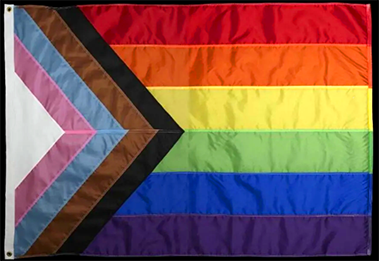 The Language of Pride, Victoria & Albert Museum, London.
This page, produced by the V&A’s LGBTQ+ Working Group, “explores the emergence of symbolic identity as a design language for the community”. This flag is the Progress Pride flag, designed by non-binary artist Daniel Quasar, which sought to include trans, people of colour, and those affected by HIV, in the Pride flag’s iconography.
Available at <https://www.vam.ac.uk/dundee/articles/the-language-of-pride> (Opens in a new tab or window).
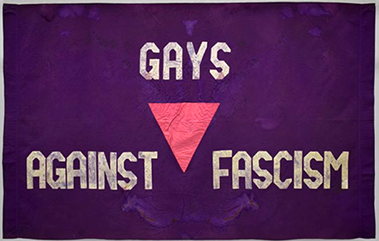 LGBTQI+ symbols and their meanings, People’s History Museum, 2024.
The downwards pointed pink triangle was used by Nazi Germany to identify LGBTQ+ people in concentration camps, but has since been reclaimed by LGBTQ+ people, similarly to how the word queer, once a common slur, has since been adopted as a broad term to include all non-heteronormative sexual and gender identities.
Available at <https://phm.org.uk/blogposts/lgbt-symbols-meanings/> (Opens in a new tab or window).
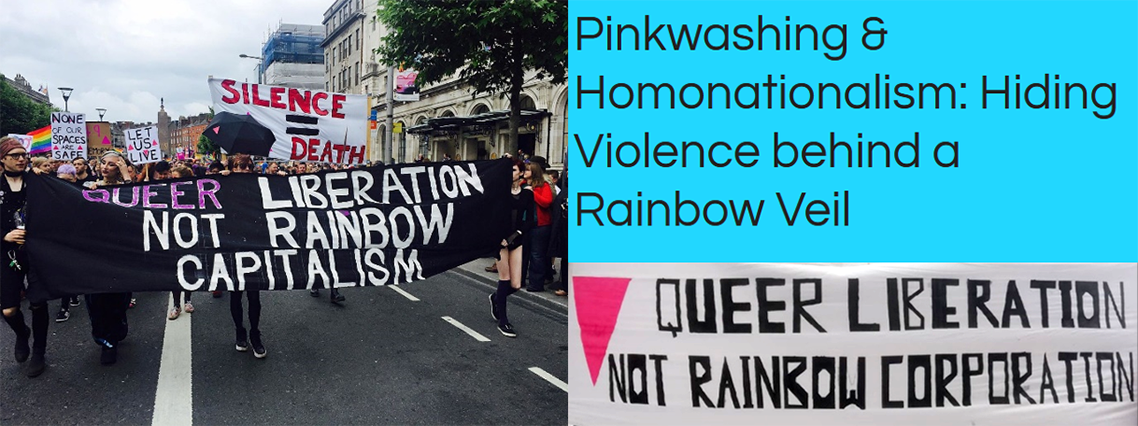
Clockwise from bottom right: examples of banners in Pride Marches in Dublin and Cork in protest of pinkwashing; right: The International LGBTQI Youth & Student Organisation (IGLYO), ‘Pinkwashing & Homonationalism: Hiding Violence behind a Rainbow Veil’, 2023.
Available at <https://www.iglyo.org/resources/pinkwashing-and-homonationalism-article> (Opens in a new tab or window).
Colonialism, Supranational Organisations, and the Law
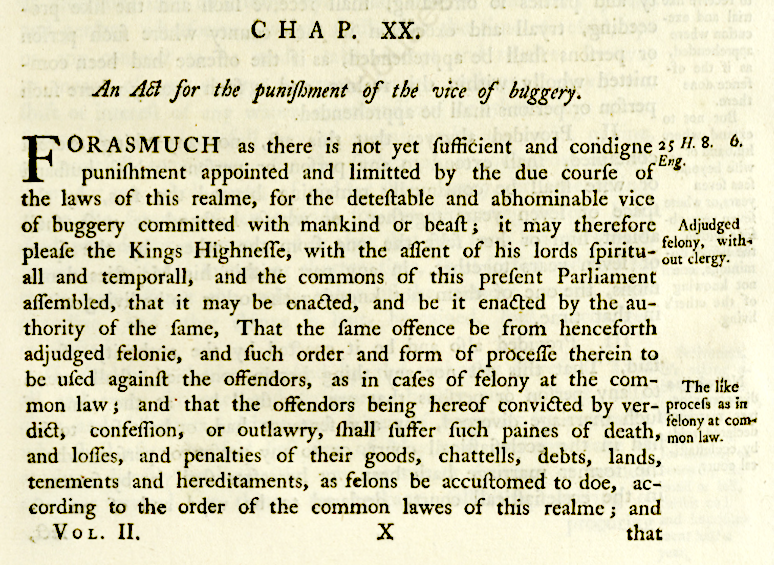
The image in Figure 2 is from The Statues at Large Passed in the Parliaments Held in Ireland: From The Third Year of Edward the Second, A.D. 1310, to The First Year of George the Third, A.D. 1761 inclusive, published in Dublin, 1765. It records the text of the Act passed by the Parliament of Ireland in 1634 which criminalised buggery, i.e., anal intercourse, to which those found guilty were to be given the death penalty.
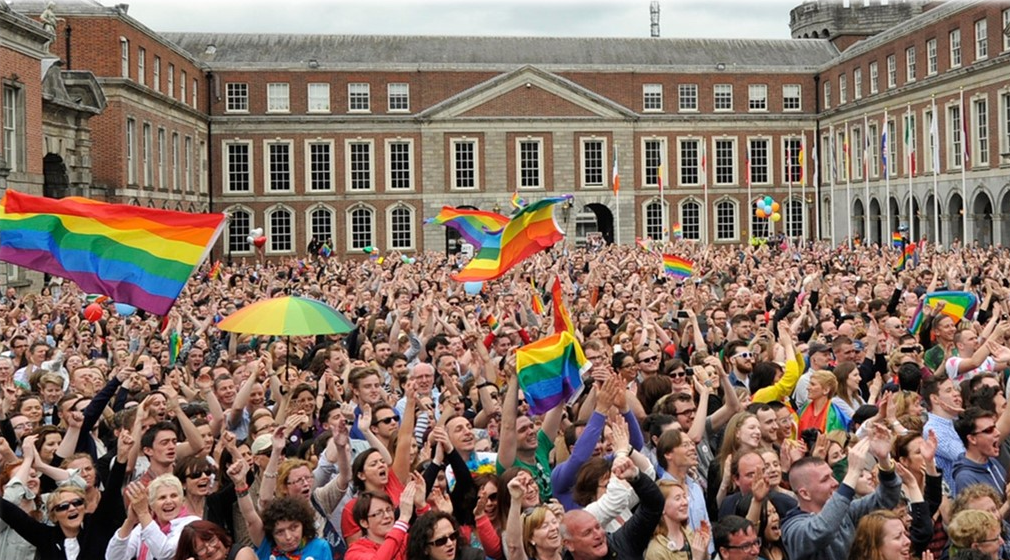
A photograph taken at Dublin Castle in 2015, on the day that it was declared that the Irish electorate had voted in favour of passing the Thirty-fourth Amendment of the Constitution to amend the Irish constitution to allow same-sex marriage.
Available at <https://www.rte.ie/archives/2018/0628/973935-marriage-equality-in-ireland/> (Opens in a new tab or window).
Legality is a framework in which to examine and understand the progress of LGBTQ+ liberation. In 1534, the Parliament of England passed An Acte for the punishment of the vice of Buggerie (25 Hen. 9. C. 6), which introduced the death penalty for those convicted of sodomy, a term which generally refers to anal intercourse; this law was implemented in Ireland in 1634. In 1861, the Parliament of the United Kingdom of Great Britain and Ireland introduced the Offences against the Person Act 1861 (24 & 25 Vict. C. 100) (link below), in which Sections 61 and 62 legislated against buggery and attempted buggery respectively. The death penalty for buggery was abolished, and was replaced with the punishment of penal servitude, i.e., forced labour, for a minimum of ten years.
In 1885, the Parliament of the United Kingdom introduced the Criminal Law Amendment Act 1885 (48 * 49 Vict. C. 69), in which Section 11 (also known as the Labouchere Amendment) criminalised ‘gross indecency’, expanding the ability to prosecute gay men beyond the specific accusation of sodomy. In 1977, civil rights activist David Norris initiated a High Court action seeking for the Supreme Court to invalidate and delete both the 1861 and 1885 Acts, on the basis that the Bunreacht na hÉireann (‘Constitution of Ireland’) adopted in 1937, was to repeal any laws that would be incongruent with the new constitution. In 1988 the European Court of Human Rights decided in Norris’ favour, stating that the two Acts were in contravention of Article 8 of the European Convention on Human Rights (link below), of which Ireland was a signatory; the article states:
- Everyone has the right to respect for his private and family life, his home, and his correspondence.
- There shall be no interference by a public authority with the exercise of this right except such as is in accordance with the law and is necessary in a democratic society in the interests of national security, public safety or the economic well-being of the country, for the prevention of disorder or crime, for the protection of health or morals, or for the protection of the rights and freedoms of others.
In 1993, the Criminal Law (Sexual Offences) Bill 1993 (link below) was enacted, decriminalising homosexual acts between men. In 2015, a referendum was held concerning the Thirty-fourth Amendment of the Constitution (Marriage Equality) Act 2015 (link below), which added a new section Article 41 of the Bunreacht na hÉireann
Marriage may be contracted in accordance with law by two persons without distinction as to their sex.
Sixty-two percent voted in favour of amending the constitution: Ireland was the first country to legalise same-sex marriage via referendum.
Section links
Offences against the Person Act 1861 (24 & 25 Vict. C. 100).
Available at <https://www.irishstatutebook.ie/eli/1861/act/100/enacted/en/print.html> (Opens in a new tab or window).
Article 8 of the European Convention on Human Rights.
Available at <https://fra.europa.eu/en/law-reference/european-convention-human-rights-article-8-0> (Opens in a new tab or window).
Criminal Law (Sexual Offences) Bill 1993.
Available at <https://www.irishstatutebook.ie/eli/1993/act/20/enacted/en/html> (Opens in a new tab or window).
Thirty-fourth Amendment of the Constitution (Marriage Equality) Act 2015.
Available at <https://www.irishstatutebook.ie/eli/2015/ca/34/enacted/en/index.html> (Opens in a new tab or window).
Legal Status in a Global Context
The map is not the territory. – Alfred Korzybski.
According to Human Dignity Trust, as of 2024 there 63 countries which criminalise LGBTQ+ people, 12 countries that may impose the death penalty.
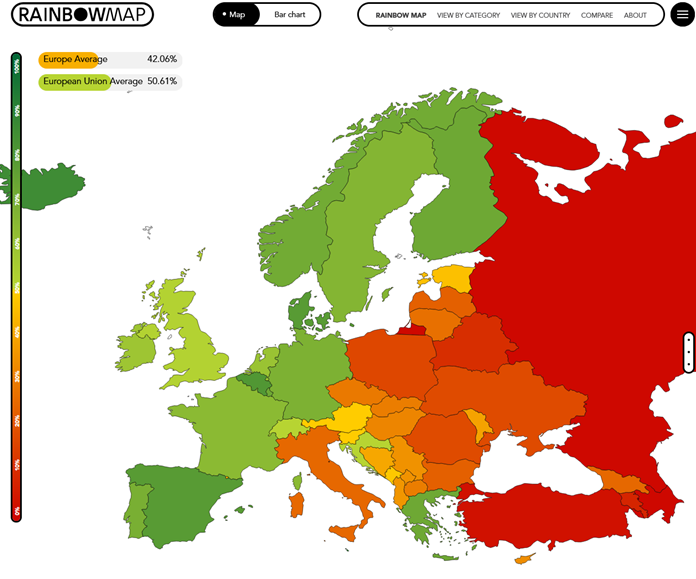
The resource presents a series of maps to to help introduce Ireland’s legislative progress with respect to LGBTQ+ issues in a global context. For example:
International Lesbian, Gay, Bisexual, Trans and Intersex Association – Rainbow Europe Map.
Available at <https://rainbowmap.ilga-europe.org/> (Opens in a new tab or window).
Available at <https://www.humandignitytrust.org/lgbt-the-law/map-of-criminalisation> (Opens in a new tab or window).
The Rainbow Europe map demonstrates that policy and legislative change is multi-faceted, and how maps can at first glance be misleading. For example, Ireland scores high with respect to freedom of association and expression for LGBTQ+ people, but scores low in relation to laws concerning the bodily integrity of intersex persons. Some categories are not explicitly measured by the Rainbow Europe map, such as legislation and healthcare for Transgender people. The Transgender Equality Network Ireland (TENI), for example, has highlighted how the provision of healthcare for transgender people is the worst in Europe.
Available at <https://teni.ie/trans-healthcare-another-way-is-possible/> (Opens in a new tab or window).
The resource document presents additional maps in this section. The link to download the resource is at the top of this page (click yellow arrow on the rigt).
Questions and activities
Reading
Consider the maps and resources above, and read the following articles:
- Anthony, Daniel. ‘Exploring the legacy of colonial homophobia in Africa’. Gay Community News, 31 July 2024.
Available at <https://gcn.ie/legacy-colonial-homophobia-africa/> (Opens in a new tab or window). - Azevedo, Anna, Luiz Mott. ‘The Colonial Roots of Homophobia’. Zeitgeister: The Cultural Magazine of the Goethe-Institut, July 2021.
Available at <https://www.goethe.de/prj/zei/en/art/22303917.html> (Opens in a new tab or window). - Buckle, Leah. ‘African sexuality and the legacy of imported homophobia’. Stonewall Scotland, 1 October 2020.
Available at <https://www.stonewall.org.uk/about-us/news/african-sexuality-and-legacy-imported-homophobia> (Opens in a new tab or window). - Fanucci, Beatrice. ‘How British colonialism left a legacy of homophobia around the world’. Gay Community News, 20 December 2023.
Available at <https://gcn.ie/british-colonialism-legacy-homophobia/> (Opens in a new tab or window). - Kelleher, Patrick. ‘All 64 of the countries where it’s illegal to be LGBTQ+ – and yes, it’s all colonialism’s fault.’ PinkNews, 21 June 2024.
Available at <https://www.thepinknews.com/2024/06/21/how-many-countries-is-it-illegal-to-be-gay/> (Opens in a new tab or window).
 Questions
- Consider the Our World in Data map above. How many countries on the map were formally and/or currently colonies – do they tend to score higher or lower on average in the index?
- What role do supranational organisations such as the European Union and the United Nations play in the development of human rights law, and the protection of marginalised peoples?
- Can the liberation of LGBTQ+ people be realised fully via reform of current legal systems, or does jurisprudence itself need to be queered?
Who is correct? Senegal’s president Macky Sall, who believes that “we live in a world that is changing slowly”? Or the Ukrainian activist Olena Shevchenko, who insists that “the world is moving so fast … we have no choice but to try and catch up”? (Gevisser, 2021, 23).
- Does social begin within a society, or from external influence, or both?
- How can LGBTQ+ activists advocate for change globally and take action, without inadvertently recreating colonial dynamics?
- What role have supranational organisations such as the European Union and the United Nations played in the decriminalisation of LGBTQ+ people, and the provision of rights and protections for LGBTQ+ people?
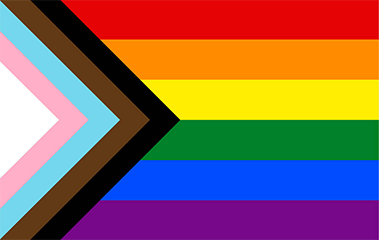 The word progress – with respect to growing progress, lack of progress, or regression – has become prominent in the discourse of LGBTQ+ activism. Consider for example, the Progress Pride flag, which was designed by Daniel Quasar to symbolise a more inclusive celebration of LGBTQ+ diversity, or the shadow report entitled Progress Made. Renewed Efforts Required by LGBT Ireland concerning the First National LGBTI+ Inclusion Strategy.
Section links
Progress Pride Flag. Available at <https://www.vam.ac.uk/articles/the-progress-pride-flag> (Opens in a new tab or window).
Progress made. Download available at <https://lgbt.ie/wp-content/uploads/2024/01/Full-Report-Progress-Made.-Renewed-Efforts-Required.-A-Shadow-Report-of-Irelands-First-National-LGBTI-Inclusion-Strategy.pdf> (Opens in a new tab or window. To download, right-click and “Save as”: PDF).
However, the term progress raises a number of complexities concerning the metaphysics of history:
- What do we, and others, understand by the concept of progress?

Available at <https://www.queeringthemap.com/> (Opens in a new tab or window).
Queering the Map is a community counter-mapping project which seeks to situate LGBTQ+ voices across the globe.
- Consider the implications of this counter-mapping project in the context of the ongoing Israeli genocide of the Palestinian people. How does a community counter-mapping project such as Queering the Map respond to pinkwashing?
Human rights can be understood to have a ‘moral life’ (as ‘[they express] urgent human concerns and claims that must not be violated or ignored’), a ‘legal life’ (as [they are] enshrined in national constitutions and in lists of basic rights, as well as in international declarations, covenants, and treaties’) and a ‘political life’ (as ‘[they express] standards of basic political legitimacy (Forst, 2017). LGBTQ+ activists and movements have, from their onset, sought to approach LGBTQ+ liberation within a human rights framework: however, as Thoreson notes, ‘human rights are not ideologically neutral’ (Thoreson, 2017).
- What do human rights mean, and where to do they come from?
- How can GCDE practitioners advocate and imagine a human rights framework which meets not only the needs of LGBTQ+ people and communities today, but is inclusive such that it can anticipate and prevent any harm or oppression or denial of rights to any potentially marginalised group?
Case study: Advocacy and Action between Towns and Cities
In 2020, the town of Fermoy, Co. Cork, absolved its town-twinning agreement with the Polish town of Nowa Dęba, after it passed a motion seeking to ‘oppose LGBT ideology’, as part of what was seen as a growing movement in Poland to establish ‘LGBT-free zones’ (link below).
Fermoy taking action to end its twinning agreement with Nowa Dęba can be seen as an action; in addition, initiatives such as the Rainbow Cities Network illustrate proactive attempts to foster positive international relationships between urban centres, advocating that local governments take action to foster positive inclusion and visibility for LGBTQ+ people and communities.
Twin towns. GCN magazine. Available at <https://magazine.gcn.ie/articles/216719?article=132-1> (Opens in a new tab or window).

Available at <https://www.rainbowcities.com/> (Opens in a new tab or window).
‘[…] cities have steadily worked to banish their customary denizens – the poor, the communities of colour, the immigrants, and marginalised queers who remember the days when queerness was not the sign of respectability and consumption. Queerness would become that, however, through the machinations of city executives and corporate leaders’ (Ferguson, 2019, 81).
- Consider the Rainbow Cities Network’s ‘Rainbow Cities in Action: Policy Guidelines for Municipalities’. How can GCDE models advocate for local and municipal governments to contribute, support, and develop LGBTQ+ inclusive policies, without ‘invalid[ating] the forms of creativity evolved by economically and racially disfranchised queer and trans people, non-normative and insurgent forms of creativity that [attempt] to produce alternative and in some cases [radical] households and communities?
Section link
Rainbow cities in action. Download available at <https://www.rainbowcities.com/wp-content/uploads/2024/01/Rainbow-Cities-in-Action-Policy-Guidelines_english_221123_online.pdf> (Opens in a new tab or window. To download, right-click and “Save as”: PDF).
Reading
Section link
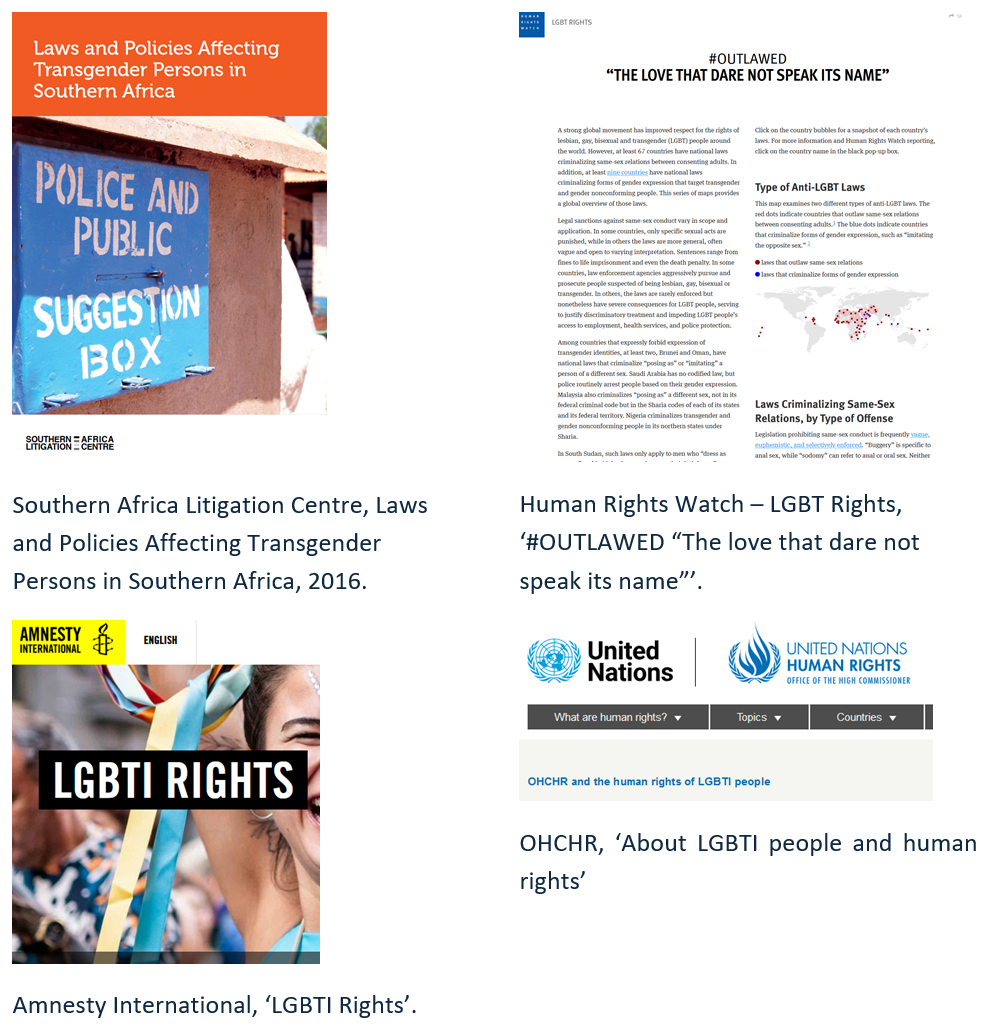
Southern Africa Litigation Centre. Download available at <https://www.southernafricalitigationcentre.org/wp-content/uploads/2017/08/Transgender-Rights-Booklet.pdf> (Opens in a new tab or window. To download, right-click and “Save as”: PDF).
Human rights watch. Available at <https://features.hrw.org/features/features/lgbt_laws/> (Opens in a new tab or window).
Amnesty international. Available at <https://www.amnesty.org/en/what-we-do/discrimination/lgbti-rights/> (Opens in a new tab or window).
OHCHR. Available at <https://www.ohchr.org/en/sexual-orientation-and-gender-identity/about-lgbti-people-and-human-rights> (Opens in a new tab or window).
The Yogyakarta Principles
Available at <https://www.rfsl.se/en/organisation/international/experts-release-much-anticipated-expansion-yogyakarta-principles/> (Opens in a new tab or window).
‘In 2006, in response to well-documented patterns of abuse, a distinguished group of international human rights experts met in Yogyakarta, Indonesia to outline a set of international principles relating to sexual orientation and gender identity. The result was the Yogyakarta Principles: a universal guide to human rights which affirm binding international legal standards with which all States must comply. They promise a different future where all people born free and equal in dignity and rights can fulfil that precious birthright’. (The Yogyakarta Principles, 2016).
Queer Approaches
Fatima Naeem Abdurrahman’s doctoral thesis, Black Holes: Finding Them, Building Instruments that Help You Look, and how Systemic Racism can Prevent You From Doing Any of, explored how systemic racism within astrophysics departments not only causes serve harm to staff and students, but also shows how the kinds and diversity of knowledge that is produced can be constrained and limited, notably with regard to claim that that academic disciplines such as astrophysics are ‘apolitical’:
Below are further examples of how various disciplines can be approached whilst being mindful of how they intersect with the issues affecting LGBTQ+ folx and communities, in addition to their global context.
Architecture / Urban Planning
‘LGBTQIA+ Architecture: 10 Professionals from the Global South’ – ‘When searching on the subject, North American and European architects such as Amaza Lee Meredith, Andrés Jaque, Eileen Gray, Joel Sanders, Julia Morgan, Mario Gooden, Paul Rudolph are most often mentioned. However, there are several outstanding professionals from the South who deserve to be remembered because of their work in different contexts and environments and their contribution to global architecture. Here are ten of them’ (Arquitetura Bicha, Arch Daily, 2021).
‘Queering Urbanism: Planning for LGBTQ Populations in the Global South’ – ‘This presentation reviews the relationship between urban planning and LGBTQ spaces in North America/ Europe and considers the usefulness of these lessons for urban planners working in the Middle East and Sub-Saharan Africa. The author uses a queer and post-colonial perspective to deconstruct these experiences and consider what might be relevant in the context of several cases from the Global South (Istanbul, Cairo, and Cape Town)’ (The Bartlett, UCL Faculty of the Built Environment, 2023).
Section link
Arquitetura Bicha, Arch Daily, 2021. Available at <https://www.archdaily.com/965086/lgbtqia-plus-architecture-10-professionals-from-the-global-south> (Opens in a new tab or window).
 Video
Video
Queer urbanism. Video available at <https://www.youtube.com/watch?v=IXxmEsuIIT4> (Opens in a new tab or window).
Healthcare
Transcare 2024 Conference (University College of Cork) – ‘Cultivating Intersex, Trans- and Gender-Diverse Inclusive Education in Healthcare. Feminist, Trans, and Queer Perspectives […] An interdisciplinary conference to discuss the needs and concerns of intersex, trans and gender-diverse people in health settings and envision gender-affirmative education for healthcare professionals’.
‘LGBTIQ+ wellbeing in the global south’ – (WorldPride, Copenhagen, 2021).
Section link
Transcare conference 2024. Available at <https://www.ucc.ie/en/transcare/> (Opens in a new tab or window).
Video
WorldPride. Video available at <https://www.youtube.com/watch?v=Htl5R6-WxmU> (Opens in a new tab or window).
Further reading on Healthcare and LGBTIQ+
Bass, Brittany, et al. “Cultural Competence in the Care of LGBTQ Patients”. Treasure Island (FL): StatPearls Publishing; 2024 Jan. Available at <https://www.ncbi.nlm.nih.gov/books/NBK563176/> (Opens in a new tab or window).
Brown, Michael, et al. “The Inclusion of LGBTQ+ Health across the lifespan in Pre-Registration Nursing Programmes: Qualitative Findings from a Mixed-Methods Study”. Healthcare (Basel) 11:2 (2023). DOI: <https://doi.org/10.3390%2Fhealthcare11020198> (Opens in a new tab or window).
Dworkin, Emily R., and Barbara Krahé and Heidi Zinzow. “The Global Prevalance of Sexual Assault: A Systematic Review of International Research Since 2010”. Psychol Violence 11:5 (2021): 497-508.
Fu, Michael X et al. “Medical students’ perceptions of LGBTQ+ healthcare in Singapore and the United Kingdom”. Frontiers 10 2023. DOI: <https://doi.org/10.3389/fmed.2023.1236715#> (Opens in a new tab or window).
Human Rights Watch. “Understanding Intimate Partner Violence in the LGTBQA+ Community”. Resources (2022). Available at <https://www.hrc.org/resources/understanding-intimate-partner-violence-in-the-lgbtq-community> (Opens in a new tab or window).
Hwahng, Sel J, and Michelle R. Kaufman (eds.). Global LGBTQ Health: Research, Policy, Practice, and Pathways. Berlin: Springer, 2024.
Jane A. McElroy, Bennett J. Gosiker. “Sexual and Gender Minority Population’s Health Burden of Five Noncommunicable Diseases: Cardiovascular Disease, Cancer, Diabetes, Asthma, Chronic Obstructive Pulmonary Disease”. In Hwahng, Sel J., et al. Global LGBTQ Health: Research, Policy, Practice, and Pathways. Berlin: Springer, 2024, 93-145.
Kluczynski, Jonathan. “The World Health Organisation’s Ambivalence Toward LGBT Health”. Global Health Institute, 2018. Available at <https://globalhealth.georgetown.edu/posts/the-world-health-organization-s-ambivalence-toward-global-lgbt-health> (Opens in a new tab or window).
Lampe, Nik M., et al. “Health Disparities Among Lesbian, Gay, Bisexual, Transgender, and Queer Older Adults: A Structural Competency Approach”. The International Journal of Aging and Human Development 98:1 (2023).
M. Helms, “How Hate and Discrimination Affects the Health of Transgender People” (Presented at the Lessons Learned from Rights Based Approaches to Health international conference, Session on Sexual and Gender Minorities, Atlanta, Georgia, April 14, 2005).
Medina-Martínez, Jorge. “Health Inequities in LGBT People and Nursing Interventions to Reduce Them: A Systematic Review”. Int J Environ Res Public Health 18:22 (2021). DOI: <https://doi.org/10.3390%2Fijerph182211801> (Opens in a new tab or window).
Pillay, Suntosh R. “Queering Global Health: an urgent call for LGBT+ Affirmative practices”. Viewpoint 10:4 (2022): 574-578.
Richard Bränström, Tonda L. Hughes, John E. Pachankis. “Global LGBTQ Mental Health” In Hwahng, Sel J., et al. Global LGBTQ Health: Research, Policy, Practice, and Pathways. Berlin: Springer, 2024, 45-78.
S. Wilson Beckham, Jennifer Glick, Jowanna Malone, Ashleigh J. Rich, Andrea Wirtz, Stefan Baral. “HIV/AIDS Among Sexual and Gender Minority Communities Globally”. In Hwahng, Sel J., et al. Global LGBTQ Health: Research, Policy, Practice, and Pathways. Berlin: Springer, 2024, 183-220.
Wesley, Connor, et al. “Patient Safety Concerns and the LGBTQ+ Population”. Patient Safety Network (2023). Available at <https://psnet.ahrq.gov/perspective/patient-safety-concerns-and-lgbtq-population> (Opens in a new tab or window).
Yale School of Public Health – LGBTQ Mental Health Initiative, “Global LGBTQ+ Mental Health”. Available at <https://medicine.yale.edu/lgbtqmentalhealth/projects/global/> (Opens in a new tab or window).
GLAMS (Galleries, Libraries, Archives, Museums, Special Collections)
Queer Metadata Collective – ‘The Queer Metadata Collective is a group of cataloguers, librarians, archivists, scholars, museum and information professionals with a concerted interest in improving the description and classification of queer people in Galleries, Libraries, Archives, Museums, and Special Collections (GLAMS) and other information systems. The Collective’s primary goal is to develop a set of best practices for the description, cataloguing, and classification of queer information resources in GLAMS.’
Trans Metadata Collective – ‘‘The Trans Metadata Collective is a group of dozens of cataloguers, librarians, archivists, scholars, and information professionals with a concerted interest in improving the description and classification of trans and gender diverse people in Galleries, Libraries, Archives, Museums, and Special Collections (GLAMS) and other information systems. The Collective’s primary goal was to develop a set of best practices for the description and classification of trans and gender diverse information resources. This report has now been released.
People at Trans Metadata Collective: Jasmine Burns, Michaelle Creonquist, Jackson Huang, Devon Murphy, K. J. Rawson, Beck Schaefer, Jamie Simons, Brian M. Watson, Adrian Williams. Metadata Best Practices for Trans and Gender Diverse Resources (2022).
Section links
Queer Metadata Collective. Available at <https://queermetadatacollective.org/> (Opens in a new tab or window).
Trans Metadata Collective. Available at <https://transmetadatacollective.org/> (Opens in a new tab or window).
People at Trans Metadata Collective. Available at <https://zenodo.org/records/6686841> (Opens in a new tab or window).
Mathematics
‘[…] The positioning of mathematics as neutral and objective is one of the ways that mathematics has been weaponized to support oppression […]’ (Voigt et al, 2011, 5).
Dubbs, Christopher. ‘Queer Turn in Mathematics Education Research: Centering the Experience of Marginalized Queer Students’. Student Learning and Related Factors (2016). Available at <https://eric.ed.gov/?id=ED583735> (Opens in a new tab or window).
Voigt, Matthew, and Daniel L. Reinholz. ‘Queer Acceptance and Visibility in Math / Calculating Queer Acceptance and Visibility: A Literature Synthesis on Queer Identity in Mathematics’ (2022). Download available at <https://danielreinholz.com/wp-content/uploads/2022/11/2020-Mindset-Queer-Visibility.pdf> (Opens in a new tab or window. To download, right-click and “Save as”: PDF).
Critical Pedagogy
Queer Pedagogy for, with and within education for sustainable development – ‘Queer pedagogy, as a form of critical pedagogy, rejects the influence of heteronormative and patriarchal systems and consequently also rejects anthropocentrism. To effectively educate for sustainable development, it becomes apparent that one must also educate in a queer-informed way’ (Kieran Higgins, Queen’s University Belfast, 2021).
Section links
Queer pedagogy. Download available at <https://www.ucu.org.uk/media/13249/Queer-pedagogy-for-with-and-within-education-for-sustainable-development/pdf/Queer_pedagogy_-_sustainable_development_Nov22.pdf> (Opens in a new tab or window. To download, right-click and “Save as”: PDF).
Further reading on Critical Pedagogy
Britzman, Deborah P. “Is there a Queer Pedagogy? Or, Stop Reading Straight”. Educational Theory 45:2 (1995): 151-165.
Britzman, Deborah P. “Queer Pedagogy and Its Strange Techniques”. Counterpoints (Sexualities in Education: A Reader (2012): 292-308.
Carlile, Anna. “Queer pedagogies: LGBTQ education, democracy and human rights” (review of Camicia, 2016). Human Rights Education Review 1:2 (2018): 65-67.
Misawa, Mitsunori. “Queer Race Pedagogy for Educators In High Education: Dealing with Power Dynamics and Positionality of LGBTQ Students of Color”. International Journal of Critical Pedagogy 3:1 (2010): 26-35.
Neto, Joao Nemi. “Queer pedagogy: Approaches to inclusive teaching”. Policy Futures in Education 0:0 (2018): 1-16.
O’Hara, Claerwen, and Paula Gerber. “Teaching Law Students about Sexual Orientation, Gender Identity and Intersex Status within Human Rights Law: Seven Principles for Curriculum Design and Pedagogy”. Journal of Legal Education 68:2 (2019): 416-456.
Ethics
The issue of essentialism finds place in discourses concerning both ethics and the nature of moral properties, as well as in discussions concerning gender. Judith Butler notably argued in Gender Trouble against the claim that gender was essential, asserting instead that it is wholly performative (Butler, 1990); how might approaches to ethics be queered, and how might that in turn potentially effect approaches in different disciplines? Would a non-essential or an essential approach to ethics be better suited to the liberation of LGBTQ+ folx, and for challenging norms concerning sexuality, relationships, intimacy, and care?
Further reading on Ethics
Butler, Judith. Gender Trouble. New York: Routledge, 1990.
Detamore, Mathias. “Queer(y)ing the Ethics of Research Methods: Towards a Politics of Intimacy in Researcher/Researched Relations”. In Queer Methods and Methodologies: Intersecting Queer Theories and Social Science Research. Edited by Kath Browne and Catherine J. Nash. Abingdon: Routledge, 2010.
Lamos, Colleen. “The Ethics of Queer Theory”. Critical Ethics: Text, Theory, and Responsibility. Edited by Dominic Rainsford and Tim Woods. London: Palgrave Macmillan, 1999.
Nicholas, Lucy. “Queer ethics and fostering positive mindsets toward non-binary gender, genderqueer, and gender ambiguity”. Int J. Transgend 20:2-3 (2019): 169-180.
Patnaik, Anhiti. “Crip-Queer Ethics of Care in Amruta Patil’s Kari and Sybil Lamb’s I’ve Got a Time Bomb”. Nora – Nordic Journal of Feminist and Gender Research (2024). Available at <https://www.tandfonline.com/doi/full/10.1080/08038740.2023.2300345> (Opens in a new tab or window).
Ruti, Mari. The Ethics of Opting Out: Queer Theory’s Defiant Subjects. New York: Columbia University Press, 2017.
Appendix
 Available at <https://www.stonewall.org.uk/list-lgbtq-terms> (Opens in a new tab or window). |
 Available at <https://www.belongto.org/app/uploads/2023/09/Belong-To-Education-Resource-Glossary-2023.pdf> (Opens in a new tab or window. To download, right-click and “Save as”: PDF). |
 Available at <https://lgbtqia.ucdavis.edu/educated/glossary> (Opens in a new tab or window). |
|
 Available at <https://homosaurus.org/> (Opens in a new tab or window). |
 Available at <https://www.belongto.org/support-for-someone-else/at-home/lgbtq-language/> (Opens in a new tab or window). |
== End of Resource: Global LGBTQ+ Experiences ==
© 2025. All rights reserved. Praxis UCC.
